|

|
The weekly newsletter of the Mexico Solidarity Project |
|
Every issue archived online at mexicosolidarityproject.org/archives/ |
|
February 18, 2026 |
|
|
|
Are US Guns Fueling the Drug Trade? |
|
Meizhu Lui, for the editorial team |
|
|
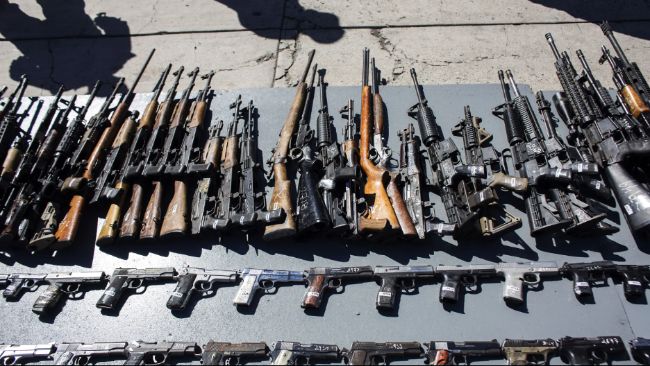
View of weapons seized by Mexican Security Forces before being destroyed at the Morelos II Military Region headquarters in Tijuana on March 5, 2018. From Border Repot: Guillermo Arias/AFP via Getty Images |
|
Dr. Patricia Escamilla-Hamm reminds us of a basic economic fact: demand doesn’t follow supply — who wants a warehouse full of CD players? — supply follows demand. If enough people want a product, someone will find a way to produce, transport and sell it. Period.
Look at alcohol. At the beginning of the 20th century, anti-alcohol crusaders knew that excessive drinking contributed to domestic violence and deaths. In 1919, their campaign led to a constitutional amendment banning alcoholic beverages.
But you can’t outlaw demand! The supply chain was now illegal, so groups of small underground entrepreneurs grew into huge criminal enterprises that fought violently to increase their market share. They had plenty of money to buy off politicians. For example, the famous gangster Al Capone paid off the mayor of Chicago, “Big Bill” Thompson, in exchange for his protection.
The government responded with guns, and the shootouts between the gangs and the police are the stuff of legend. After 13 years of crime and violence, the US public had endured enough. Alcohol was legalized. But the criminal organizations had become so strong they carried on with other illegal business.
Was nothing learned? In 1971, the US government initiated the “War on Drugs,” and, in 2006, it was extended to Mexico. “War” is the right word — the US strategy was to destroy the drug trade by military means. As a result of greed and corruption on both sides of the border, vast numbers of more and more powerful US-made arms ended up in the hands of the cartels, the Mexican equivalents of the mafia, and homicide rates skyrocketed.
In a recent breaking news report, it turns out that half the high-powered .50-caliber cartridges seized by Mexican police since 2012 were manufactured by — the US Army and its private contractors!
Mexico has had enough. But the US has doubled down. So tell me again: which country has a “culture of violence”? |
|

|
Trump’s National (In)security Strategy |
|
Patricia Escamilla-Hamm’s expertise in national security grew out of her interest in US imperialism. She taught courses on drug policy, organized crime and national security and joined a binational academic team to research US-Mexico border security at El Colegio de la Frontera Norte in Tijuana, Mexico. As a professor at the William J. Perry Center for Hemispheric Defense Studies in Washington, DC, her signature course was on combating transnational organized crime. She’s been a consultant for both the Mexican and US governments. Currently, Dr. Escamilla-Hamm lives in Mexico City and is an independent consultant, political analyst and contributor to the Small Wars Journal-El Centro. |
|

|
How possible are unilateral US military strikes on targets in Mexico?
Before Venezuela, I’d have said — unlikely. Now, given President Trump’s personality and recent history, anything is possible.
His National Security Strategy, based on Project 2025 and made public two months ago, asserts complete US dominance over the Western Hemisphere. |
|
|
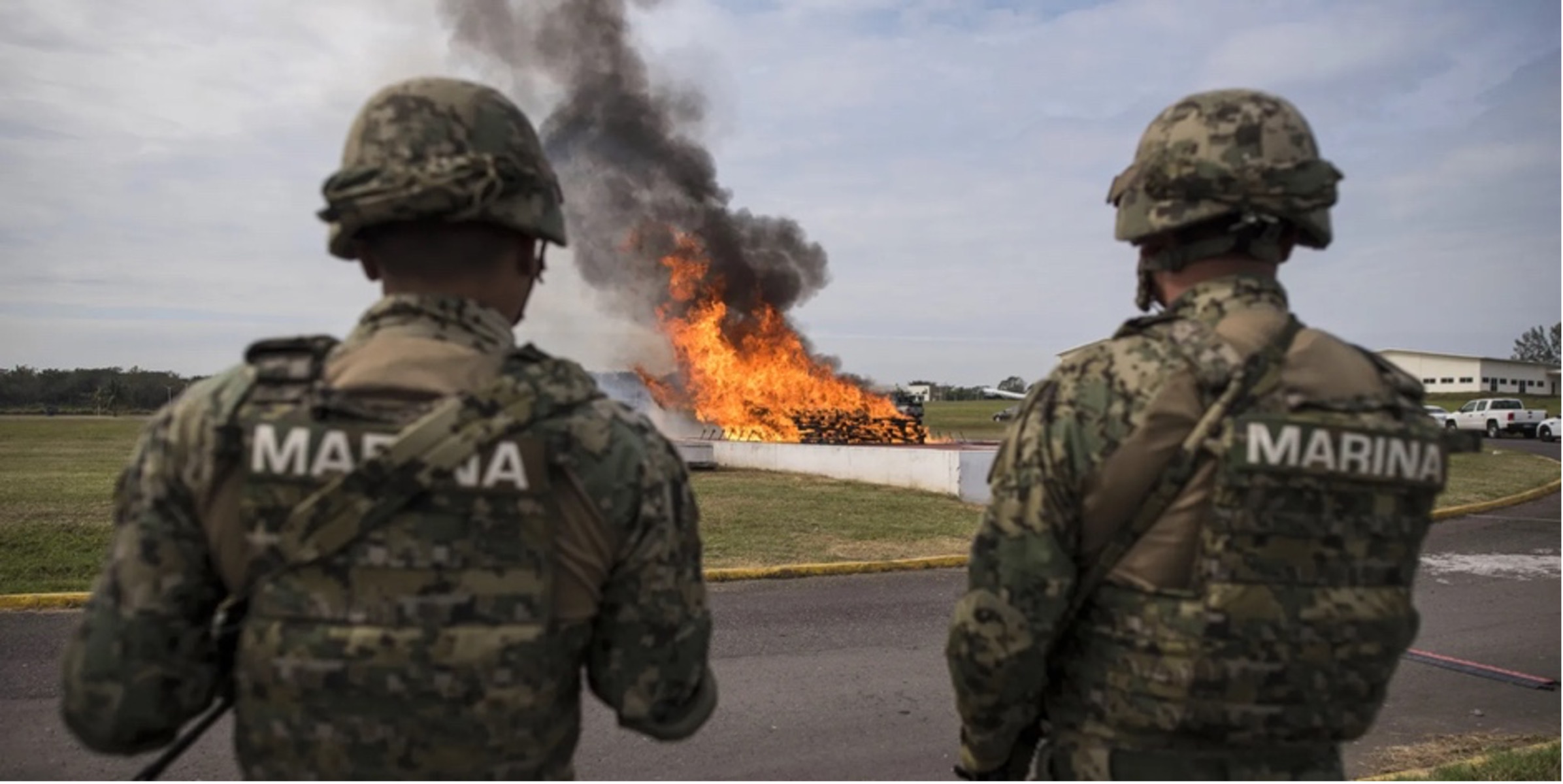
Elite US-trained Marines in Veracruz: Intercept |
|
Tactically, he could try for a dramatic “spectacle” — or he could simply keep threatening to strike Mexico, pressuring it to accept US whims while he grandstands to his base and the world. |
|
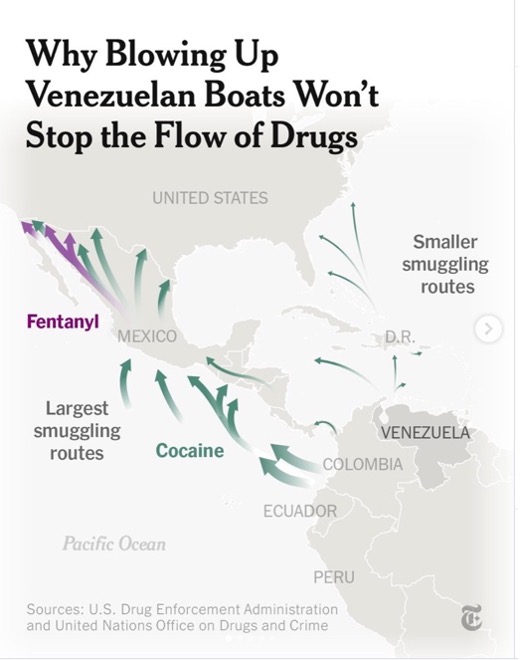
For Venezuela, his stupid excuse was to stop it from sending fentanyl to the US, but Venezuela doesn’t produce or traffic fentanyl! In threatening military strikes on Mexico, drugs were his stupid excuse again, even though trafficking went up under the very US policy that he wants to revive, and it’s decreasing under president Sheinbaum. Trump plays a double game — he wants to show his base that he’s tough on drugs while attempting to deflect attention from how US people are turning against him.
Of course, he covets Venezuela’s and Mexico’s valuable natural resources. But I think Trump’s objective is primarily political. No question, US global power is still dominant — but it’s also in decline. He’s trying to send a message that the US is still number one! |
|
|
NY Times Instagram post |
|
Some have criticized President Claudia Sheinbaum for bending to Trump’s pressure. At US's request, she transferred 92 alleged cartel members to the US. Was that a concession?
No, I don’t think that was a concession, because the transfer serves Mexico’s strategic interests. It demonstrates that kinetic strikes or other military operations are unnecessary and counterproductive in dismantling Mexican drug cartels. Military force didn’t accomplish the capture of these operatives. It was Mexico’s use of the tools of investigation, coordination and intelligence cooperation with the US Federal Bureau of Investigation that pinpointed their locations with laser accuracy.
The transfer dispelled the false allegation that Sheinbaum’s government protects drug cartels. It made evident that her government is a trustworthy and essential security partner. In turn, this encourages key US stakeholders — investors, businesses, farmer groups and others who have business interests in Mexico. They can now better lobby against unilateral military strikes, which they know would produce seriously negative results.
A crucial stakeholder is the U.S. Northern Command, or NORTHCOM, the US Armed Forces command responsible for relations between the US and Mexican militaries. I’m sure NORTHCOM Commander General Gregory Guillot considers Mexico essential for US and North American security. |
|
The US unilaterally putting boots on the ground or launching military strikes will provoke resistance and chaos and break the good working relationship between the two militaries and the two governments.
|
|
|
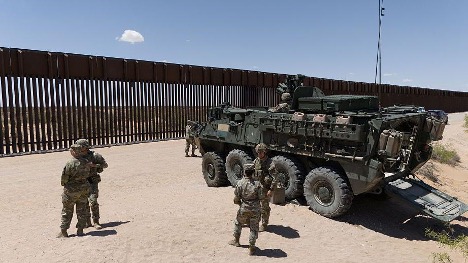
This armoured vehicle was used in Iraq - now it's stationed at the US-Mexico border: 4 June 2025: BBC News |
|
Even FBI Director Kash Patel has praised Mexico’s cooperation in decreasing the drug trade. These US leaders and other experts undercut Trump’s assertion that US military action is necessary.
So Sheinbaum’s actions shouldn’t be considered “concessions” but smart tactics.
A caveat: The 92 Mexicans were “expelled” and not “extradited,” which did raise legitimate questions from critics. Extradition is a legal process where one country requests that an individual in another country be sent to it for arrest and prosecution. Sheinbaum stated that expelling them was “a matter of security” for Mexico and “according to the law,” but expulsion just means being taken out of the country and does not require that the person face trial. It’s possible they weren’t extradited because Mexico is still working to eradicate the corruption associated with many judges inherited from the old PRI and PAN regimes, and a fair trial was not possible.
Why did the US prefer expulsion? Probably, it wants to use the prisoners as witnesses against bigger cartel leaders through plea bargaining, avoiding a full trial. That process often results in light sentences in the US and means that their victims in Mexico will not get justice.
Past presidents Andres Manuel Lopez Obrador and Joe Biden agreed that they would deprioritize the use of force. What happened?
In 2021, the US/Mexico Bicentennial Framework for Security, Public Health and Safe Communities replaced the failed, force-heavy Merida Initiative initiated in 2007. |
|
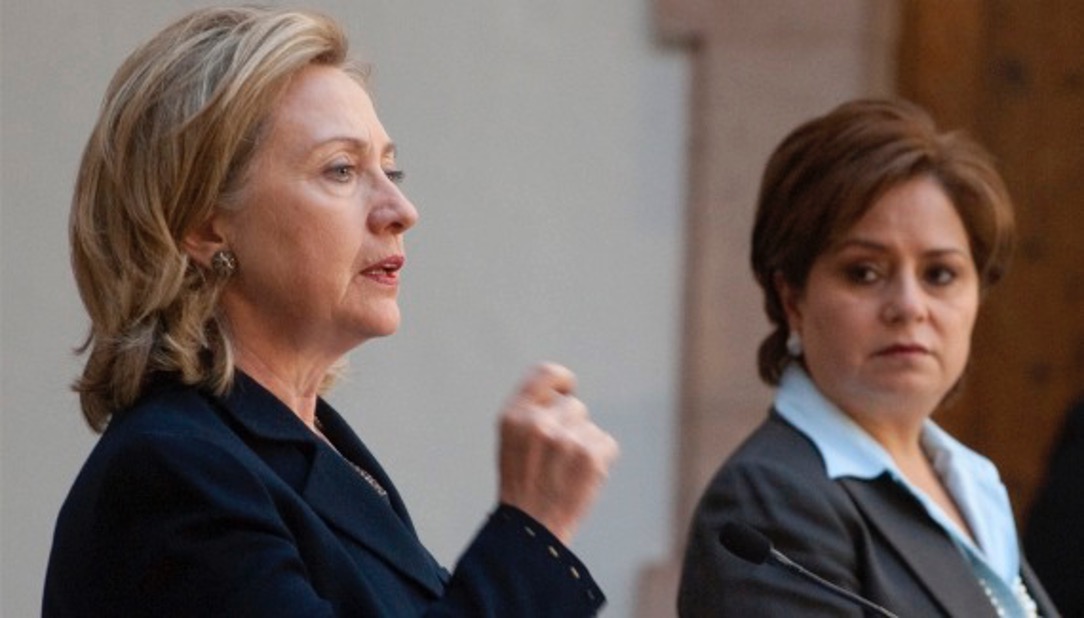
|
US Secretary of State Clinton hosting the Merida Initiative Group in Washington, with Mexican Foreign Minister Espinosa (Saul Loeb / Courtesy Reuters). |
|
The new strategy shifted from violent force with all its “collateral damage” — the accidental killing of civilians who were in the wrong place at the wrong time — to a public health approach designed to decrease the demand for drugs and to curb addiction. Prioritizing harm reduction produced good results: US fentanyl deaths have dropped over 20% since 2024. |
|
It’s guns, not drugs, that kill Mexicans. The Framework replaced sending military weapons to Mexico with intelligence and information gathering to disrupt drug cartels. Each year, an estimated 200,000 military-grade weapons are smuggled across the border into Mexico —AR15s, AK-47 machine guns, 50-caliber “cop killers” that can pierce bulletproof vests and armored vehicles, weaponized drones and RPG grenade launchers that can bring down military helicopters. |
|
Despite the Biden government’s commitment to reducing gun trafficking as an essential piece of countering drug cartels and firearms violence in Mexico, the 2nd Amendment and US gun culture remain significant obstacles. Thus, rival cartels continue deadly battles and resisting the Mexican security forces with US guns. How ironic that the US arms the enemy that it wants to defeat! |
|
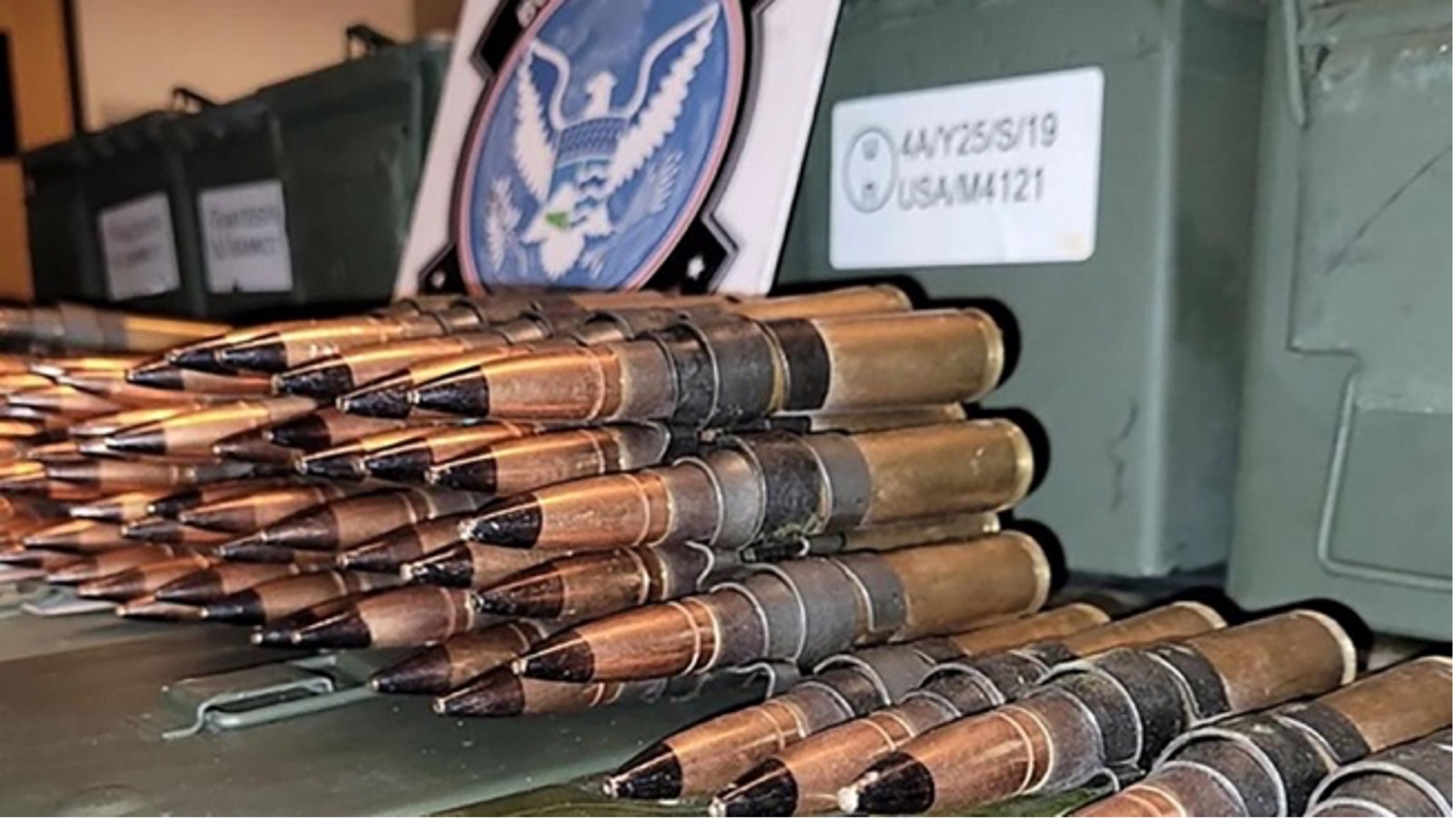
|
Munitions trafficked from US into Mexico: ABC News |
|
Nevertheless, Mexico has managed a gradual decline in the hundreds of thousands of cartel-related firearm homicides since the drug war began in 2007, when homicides rose from 28 to 100 a day. With AMLO and a new strategy, homicides gradually dropped in 2022, and by 2025, under Sheinbaum, to 64 homicides per day. Numbers are still high but are trending downward.
What made it difficult to reduce these murders? |
|
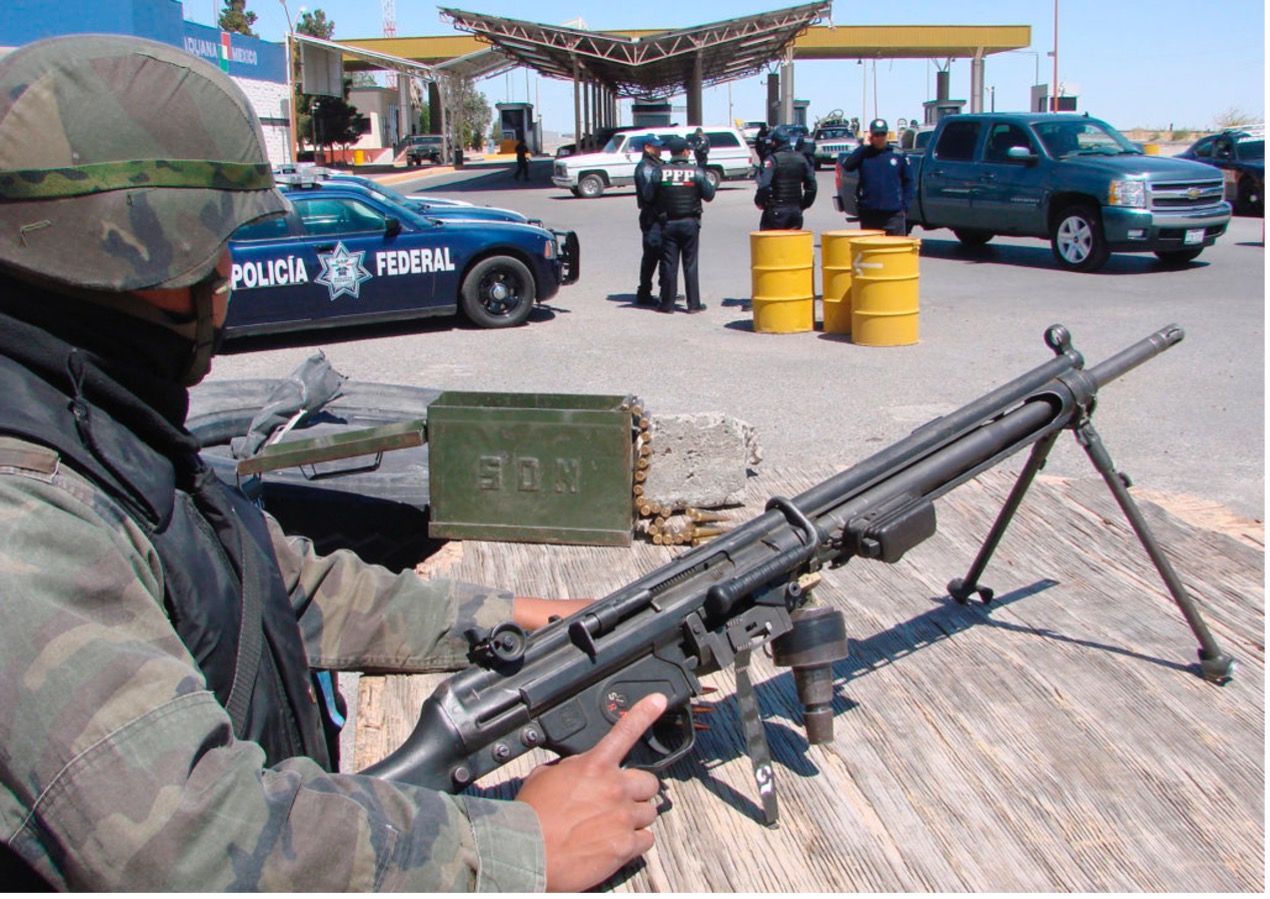
|
The flow of guns from the U.S. to Mexico gets lost in debate: PBS Newshour |
|
The continued flow of firearms and the money generated by US demand for drugs ensure that the cartels retain resilience and power. Historically, Mexico has had weak police, investigative, prosecutorial and judicial systems, especially at the local level; co-opted and coerced officials often helped facilitate cartel operations. |
|
For example, Genaro García Luna, Secretary of Public Security during the Calderón government, worked closely with the US to implement the Merida Initiative. He was eventually convicted of colluding with the Sinaloa Cartel and imprisoned in the US.
Despite advances, Mexico has more work to do. AMLO dismantled the old and irremediably corrupt Federal Police, which he replaced with a new National Guard, but he had to continue relying on the military to break up the heavily armed cartels. Sheinbaum, as mayor of Mexico City, successfully brought down crime with her Chief of Police, Omar Hamid García Harfuch, whom she appointed as the national Secretary of Security and Civilian Protection, a civilian post.
Harfuch arrested nearly 7000 drug traders and seized 58 tons of drugs in 2025. How was that accomplished?
First, Harfuch relies on improved investigations and better intelligence to make carefully targeted arrests and dismantle drug labs without putting innocent civilians in danger. Second, the election of judges has begun to dismantle the old corrupt and incompetent judicial system. Third, the aged, tired and ineffective federal attorney general was replaced. Finally, Harfuch maintains extensive dialogue with US agencies, especially the FBI, to better break up binational cartels.
It’s stupid that the US government never publicly admits that American cartels exist and operate inside the US. Americans are in on it! US citizens smuggle illicit fentanyl or other drugs across legal points of entry into the US, where they hand them off to independent American cartels. The cartels buy them on credit, then transport and distribute them across the country for sale to the final US consumers. They set the prices and launder the money to pay Mexican cartels.
But American cartels are not called “organized crime,” “cartels” or “narcoterrorists” — they are treated as common delinquents or gangs. US governments pretend that it’s only Mexicans, not Americans, who are supplying drugs to US consumers.
Still, the lamb is lying down with the lion. What security measures does Mexico need to take?
The total asymmetry of power between Mexico and the US is undeniable, and it leaves Mexico vulnerable to Trump’s military and tariff threats. |
|
While Sheinbaum’s “cool head” has kept Trump at bay — so far — the horrible possibility of a military strike demands constant vigilance. President Sheinbaum has asserted her “red line”: Mexico won’t accept unilateral violations of Mexico’s airspace, land or sea sovereignty. |
|
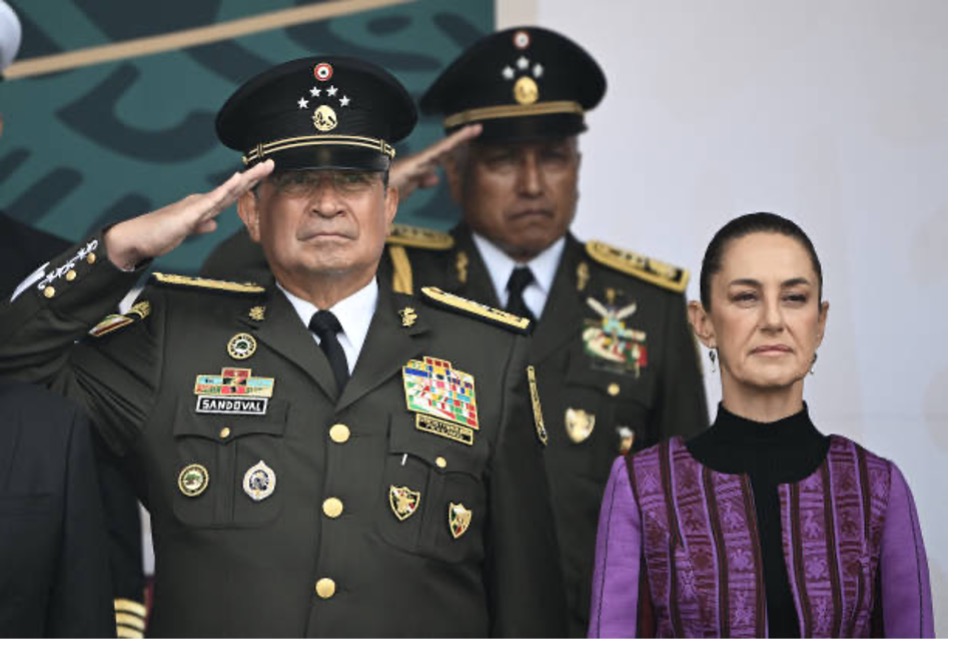
|
Sheinbaum attends an event in Mexico City: her experience as mayor points to an approach more rooted in enhanced intelligence, mediation, and deterrence. |
|
Despite Sheinbaum’s tremendous popular support — 70% approval! — and a highly nationalistic military, Mexico depends largely on geopolitical leverage to ward off US aggression. Mexico is indispensable for US border security, migration and anti-drug policy; the Mexican military is vital for broader North American security and as the US’s top trading partner, not only do Mexicans depend on US trade, but important US sectors also depend heavily on Mexican imports and exports.
Sheinbaum can use these points of leverage to open Trump’s eyes to reality. Crossing Mexico’s red line could be very costly. |
|

|
NEW! Sign up here for weekly delivery of COMPAÃEROS! |
|
Compañeros is the weekly newsletter of Mexico Solidarity Media, delivering all of our news stories, analyses, interviews and episodes of the podcasts Soberanía and El Taller, the Mexico Solidarity Bulletin, translations from Mexican media, photos and more! |
|

|
How to Debunk Anti-Immigrant Myths at Work |
|

|
Natascha is a staff writer at Labor Notes where she covers farmworkers, immigrant workers and the Mexican labor movement. She is bilingual in Spanish and English and a skilled translator. We excerpted the following piece from her much longer article of February 3, 2026. It has been edited for length and clarity. |
|
Conversations about immigration often feel loaded, especially in the workplace. How can we challenge misinformation in a way that builds solidarity with our co-workers?
Ground it in the workplace Chris Anders, a steward with Electrical Workers (IBEW) Local 666 in Virginia, does just that.
When his co-workers gripe that “they don’t really care, they ain’t real electricians, they ain’t gonna stick around,” Anders points out that some immigrant workers are participating in a union-sponsored training program for electricians to bolster their technical skills.
“We’re seeing people from my job site who are going after 10 or 11 hours of work, then a 30-minute to an hour commute, and spending another three hours in a class at night.” It makes electricians realize just how seriously some immigrants are taking the job.
If they complain that immigrants produce lower-quality work, he says, “I’ve seen a lot of dumbasses. But you’ll see dumbass electricians of every nationality.”
‘Where are you getting that?' The propaganda has been so strong… that people… not very removed from immigration are now on the side of, ‘Well, those immigrants are coming, and they’re getting free stuff,’” said Niklas Moran, a stower in an upstate New York Amazon warehouse.
So he asks, “Well, how does that immigrant raise your rent? Did your rent really increase because of poor people coming from other countries? It’s not happening! Who wants you to believe that immigrants are getting free stuff?!”
Learn by doing Some union members are wary of unions taking up “political issues” like immigration. But many have learned that fighting for immigrant members and the wider immigrant community has only strengthened the union.Ryan Andrews, an English teacher and member of United Teachers Los Angeles, told Labor Notes that UTLA’s immigrant defense organizing has gotten union members more engaged because it opened up conversations about shared values, whatever their political differences.
Tips
|
|
Sign up for a free Mexico Solidarity Bulletin subscription!
And check out:
*MEXICO SOLIDARITY MEDIA: Our website for current news and analysis in English *COMPAÑEROS: NEW! Sign up here for Mexico Solidarity Media’s weekly newsletter *¡SOBERANÍA! (Sovereignty): For entertaining exposés of events in Mexico in English, catch our podcast with José Luis Granados Ceja and Kurt Hackbarth. *Sin Muros with English subtitles: José Luis and Kurt host a weekly TV show on Canal Once that analyzes Mexico-US relations with English subtitles.
Drop a line to meizhului@gmail.com |
|

|
Recent news reports and commentaries, from progressive and mainstream media, |
|
Kurt Hackbarth, Trump Is Using Mexico’s Oil to Put the Squeeze on Cuba Jacobin. The alternative, however, is to let Cuba starve: the process of Gaza-ification brought into this hemisphere. If this were to succeed, and Mexico were to cede on an issue so symbolically important to its self-conception of sovereignty, the Trump administration would truly smell blood.
Fernando Camacho y Andrea Becerril, Morena abre centros de acopio de ayuda humanitaria para Cuba La Jornada. Respecto a la propuesta del senador Emmanuel Reyes de donar un mes de su dieta, el líder de la bancada del guinda comentó que el próximo martes en la reunión previa a la sesión, van a discutir ese punto y su propuesta será que se establezca una cantidad mínima y que de ahí hacia arriba, cada legislador done lo que considere “de acuerdo con sus convicciones, sus valores, el concepto que tenga solidaridad, de apoyo al prójimo en situaciones tan difíciles como la que enfrenta el pueblo cubano”.
Pablo Meriguet, Mexico sends shipment of humanitarian aid to Cuba People’s Dispatch. Mexico, for its part, announced that it was engaged in negotiations with the US over oil shipments.
Nancy Flores, SEMARNAT retira denuncia penal contra Grupo México por Río Sonora Contralínea. Fuentes consultadas explicaron que la autoridad ambiental puede reactivar en cualquier momento la acción penal contra el Grupo México, si éste incumple alguno de los acuerdos.
Mexican Airlines Keep Flights to Cuba Telesur. Mexican airlines confirm continued flights to Cuba by carrying round-trip fuel, despite a month-long aviation fuel shortage affecting the island.
Bárbara Zamora Los Acuerdos de San Andrés: 30 años de una deuda histórica La Jornada. Treinta años después de la firma de los Acuerdos de San Andrés, el Estado mexicano sigue en deuda con los pueblos originarios.
Emiliano Rodríguez Mega, Cartel’s Seized Ammunition Is Traced to U.S. Army Plant, Mexico Says NY Times. About 137,000 .50-caliber rounds have been seized since 2012, and of those, 47 percent came from a plant in Kansas City, Mo., Mexico’s defense secretary said.
EZLN y colectivos expresan su respaldo a Cuba ante amenaza arancelaria de Trump Resumen Latinoamericano. Aluden que el proyecto denominado “Nueva Gaza”, presentado en la reunión de los millonarios y poderosos en Davos, “es en realidad una declaración de principios: destruir y despoblar diferentes regiones del mundo, para ser reconstruidas y reordenadas por y para el capital.”
Mexico Approves Gradual Transition to 40-Hour Workweek Telesur. The Mexican Senate unanimously approved a constitutional reform on Wednesday, February 11, reducing the workweek from 48 to 40 hours, to be implemented gradually by cutting two hours per year until 2030.
SEP acepta excesos contra Marx, pero niega que quiso borrar la Guerra Sucia de libros Sin Embargo. En un comunicado, la SEP reiteró que la Nueva Escuela Mexicana continuará y señaló que se investigará el uso de policías para tratar de desalojar a Marx Arriaga. |
|
|
|

|
The Mexico Solidarity Project brings together activists from various socialist and left organizations and individuals committed to worker and global justice. We see the 2018 election of Andrés Manuel López Obrador as president of Mexico as a watershed moment. AMLO and his progressive Morena party aim to end generations of corruption, impoverishment, and subservience to US interests. Our Project supports not just Morena, but all Mexicans struggling for basic rights, and opposes US efforts to undermine organizing and Mexicoâs national sovereignty.  Editorial committee: Meizhu Lui, Bruce Hobson, Agatha Hinman, Victoria Hamlin, Courtney Childs, Pedro Gellert.  To give feedback or get involved yourself, please email us! |
|
Subscribe! Get the Mexico Solidarity Bulletin in your email box every week. |
