|

|
The weekly newsletter of the Mexico Solidarity Project |
|
Every issue archived online at mexicosolidarityproject.org/archives/ |
|
January 21, 2026 |
|
|
|
Expanding the Definition of Union Business |
|
Meizhu Lui, for the editorial team |
|
|
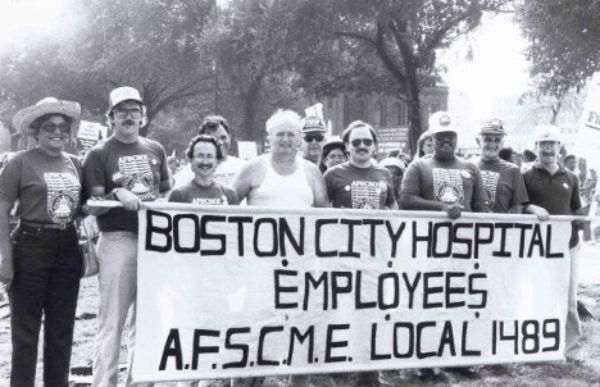
AFSCME local banner at march celebrating the 20th anniversary of the 1963 civil rights march |
|
In 1990, one of the three Boston City Hospital sites laid off their union workers, who were bumped to the main campus where I worked. The workers stepped into vacant positions, our first members from Haiti.
To integrate them into our union, we offered translation at monthly meetings, their own steward and an invitation to our Christmas party, famous — or infamous — for our open bar! No takers.
In September 1991, a fire broke out at a chicken production plant in North Carolina; 25 workers died due to locked exits. We organized a support rally at Boston’s City Hall Plaza. Before going home, we noticed another group rallying on the plaza. It was Haitians protesting the overthrow of their democratically elected and progressive president, Jean-Bertrand Aristide. And some of the workers in our hospital were leading the rally!
We felt a little ashamed to realize that while we were trying to involve them in union business and parties, they had more serious issues on their minds. They were activists and leaders in a revolutionary movement; some had risked their lives as lawyers or other professionals in Haiti before becoming orderlies and housekeepers at a US hospital.
What to do? We joined them! Our union became outspoken advocates in support of Aristide and organized others to defend democracy in Haiti. As Sean Crawford notes, when we open our hearts and minds to people different from us and engaged in their own meaningful struggles, our horizons expand.
Some years later, union organizers approached Haitian home care workers who didn’t even know or remember who we were or what union had joined their struggle. But the story had gotten around and inspired a positive idea of what unions can be. They signed up. “Solidarity forever” sounds great in any language! |
|

|
US Auto Worker: Why Support Mexican labor? |
|
Sean Crawford is a fourth-generation UAW union member and a rank-and-file labor activist. He works at the GM Tech Center in Warren, Michigan, outside of Detroit, and lives in nearby Sterling Heights with his wife and three kids. |
|

|
Why did you decide to work at an auto plant?
During the 2008 recession, when I graduated from college, my mom and I were living together. She was diagnosed with a serious illness, and I needed to make some money!
We lived in Flint, Michigan, where, in 1936, the newly formed United Auto Workers, or UAW, conducted its famous sit-down strike at General Motors. |
|
|
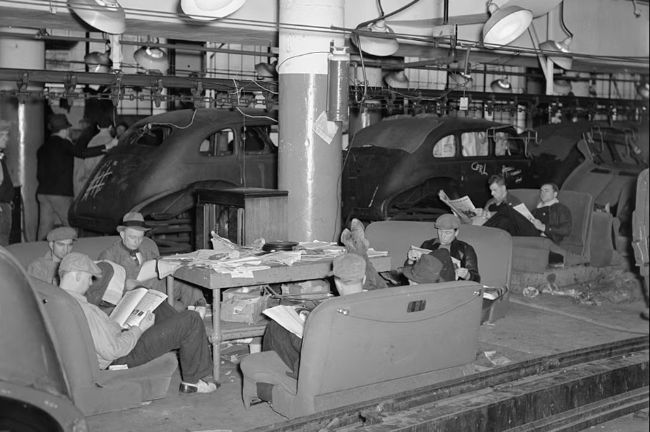
Sit-down strikers in the Fisher body plant factory number three. Flint, Michigan, 1937: Wikimedia Commons |
|
The strikers didn’t picket outside where they’d be dispersed by police — they sat down and occupied the plants and shut down production! That strike demonstrated the power of organized workers and set off a wave of organizing across the country.
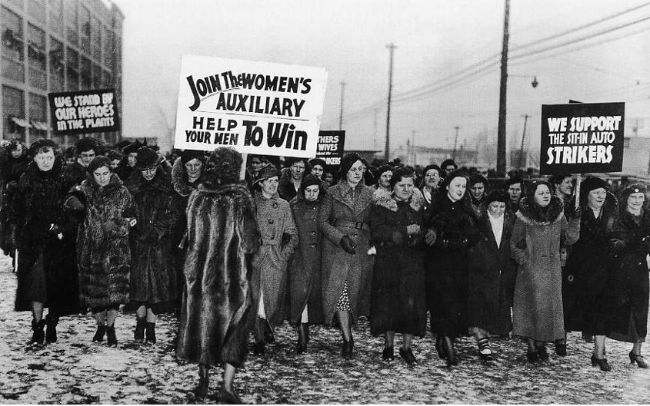
My great-grandfather was the vice-chair of the committee for the Sit-Down at Fisher Body Plant No. 1. The Women's Emergency Brigade maintained supply lines for the men inside and rallied the community to picket outside; women played a pivotal role in winning the strike. |
|
|
The Women’s Emergency Brigade, formed to bolster picket lines and provide logistical support. |
|
My tough grandma and grandaunt were in that brigade, and they took care of me while my mom worked and often brought me along to UAW meetings, which they kept participating in regularly. I learned early that it wasn’t having a job in auto — a union contract was what lifted you from poverty.
For decades, a UAW worker could own a home, send their kids to college, and have a secure retirement. Is that still true?
It depends on the specific UAW job, what class of worker you are, and what contract you work under — auto has many subsets of workers.
Your date of hire also matters. I started working for GM in 2008, and new workers like me were in tier two of a two-tier system. We made half the wages for the same work as more senior tier one workers and got substandard health and retirement benefits. Starting in about 2016, we now earn the same as tier 1, but while they have pension payments based on their previous wages guaranteed by GM, we have pensions based on contributions to a private 401(k) plan. Our benefits fluctuate with the market — we workers bear the risk.
That said, if you are under the main contract, it’s still a path out of poverty.
Why did the UAW leadership stop fighting for better wages and working conditions for all their members?
What my grandma called “pork choppers” came to dominate the UAW leadership — officers who lined their own pockets instead of fighting for the workers. The moral corruption led to an actual financial corruption scandal, which put the UAW under a federal monitor.
In the 1980s, employers widely touted the “team concept,” a neoliberal idea designed to stop union militancy. Owners, managers and workers were supposed to be partners on the same team. UAW leaders got way too cozy with management, content to have their cigars lit by paid models and put up in fancy hotels for corporate meetings. Go along to get along became the UAW culture.
When did you become active in the UAW?
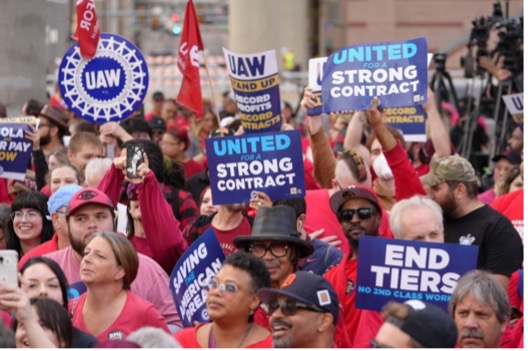
In 2011, I was elected alternate shop steward just after I started the “no more tiers” campaign. |
|
|
Photo: UAW on Twitter |
|
The UAW leadership tried to squash the campaign with name-calling and threats. Some tier 1 workers didn’t support us; we call that having “golden handcuffs.” Once some people have a good deal, they get complacent and don’t want to rock the boat. Regardless, every Wednesday, we kept wearing our red campaign shirts to demand equality.
In 2019, a group of us founded Unite All Workers for Democracy, or UAWD, a rank-and-file caucus to end corruption, win better contracts and become a bottom-up democratic union. Our push to directly elect international union officers paved the way for Shawn Fain to win the presidency in 2023. While UAWD dissolved in 2025 due to persistent infighting, I’m proud of what we achieved, and the reform movement continues with our new organization, UAW Member Action.
When some auto plants moved to Mexico, it was framed as “Mexican workers are taking our jobs,” as if they made the decision to move factories! Why did so many US autoworkers buy this absurd argument?
If you question whether Mexican workers are to blame, you have to question the whole capitalist system and who it benefits, and we’re trained not to ask those hard questions. Our ruling class doesn’t want workers to understand that their interests and those of the corporate elite conflict. They cover up class antagonism with “nationalism.”
But what other narratives have people heard? None! Do they know that socialists founded the UAW? That in Northern Europe, workers are better off because of policies enacted by labor and socialist parties in government? |
|
We don’t understand “class” here; we teach people that it’s all about individuals and that if you try hard enough, you can become part of the elite. You don’t see how racism and nationalism benefit only the capitalist class. You blame the victim — even if the victim is yourself!
The bottom line is if corporate executives can cut labor costs by moving to Mexico, they will. They don’t care about us. As some auto exec once said, “I don’t make cars, I make money!” |
|
|
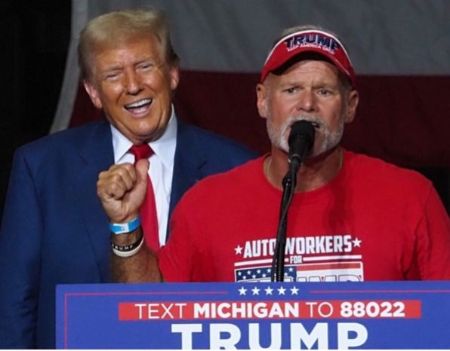
Then-candidate Donald Trump rallies with an auto worker at Alro Steel in Potterville, Michigan, on Aug. 29, 2024. (Photo by Anna Liz Nichols/Michigan Advance) |
|
After his 2023 election, Shawn Fain stated his support for Mexican autoworkers and welcomed a representative from the independent Mexican union, SINTTIA, to the UAW Convention. But then he publicly supported Trump’s tariffs, and trust between SINTTIA and the UAW broke down!
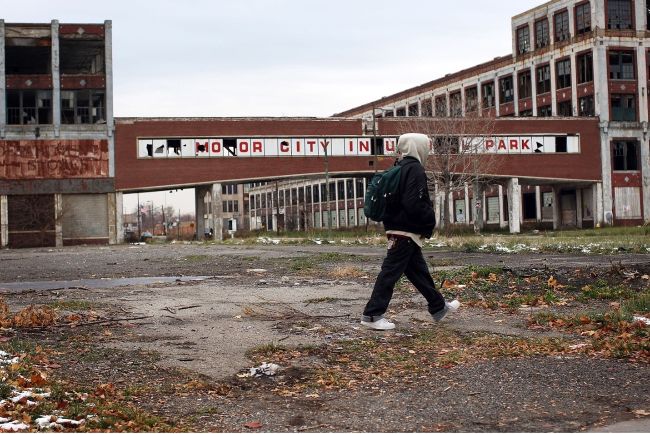
Shawn’s strategy is to address a broad sentiment in the “Rust Belt,” so called because so many manufacturers abandoned their factories. Flint was once a proud and prosperous city with the highest worker incomes in the country, and now it’s a hollowed-out shell. Drug addiction has skyrocketed —it’s become a violent, hopeless place for many. UAW members want the good jobs back that they remember. |
|
|
Detroit, a major Rust Belt city. Spencer Platt/Getty Images |
|
Shawn feels he must be pragmatic in the face of the stark reality of the Trump White House. And tariffs can be pro-worker. For the USMCA renegotiation, the UAW is recommending that tariffs be levied on vehicles made outside the US if certain wage and working conditions are not met, as a way to equalize auto jobs across borders. Shawn understands that keeping US jobs requires lifting Mexican workers.
How can rank-and-file workers solidify relationships with Mexican workers?
We need the empathy that comes from recognizing that Mexican workers, like us, simply want a decent job to provide for their families. We are all human beings and members of the same working class. How to create solidarity? I’d love to see Mexican auto workers touring UAW towns in the US, or US auto workers touring plants in Mexico, so rank-and-file workers meet face to face. And a campaign to spread what we learn. |
|
|
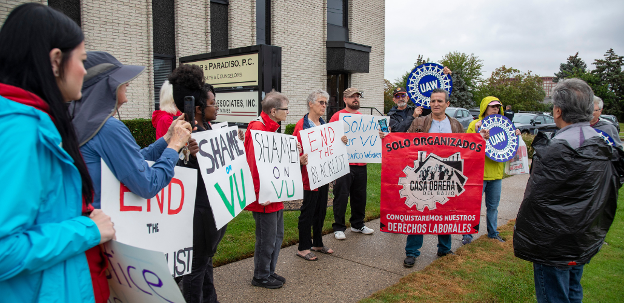
U.S. auto workers protested auto parts supplier VU Manufacturing in Detroit, Michigan last fall. After Mexican workers voted to join an independent union, VU shut down their plant and got them blacklisted from other jobs. The United Auto Workers is backing the growing independent union movement in Mexico, recognizing its importance for workers on both sides of the border. Photo: Jim West/jimwestphoto.com |
|
We could use a transnational autoworkers’ union. Why should corporations be the only ones exerting power across borders? Only an internationally organized working class can fight an international ruling class without cross-border whipsawing.
In those union meetings with my grandma and grandaunt we held hands and sang “Solidarity Forever.” It was a spiritual experience. When we deny the humanity of people of other races and nationalities, we are actually denying ourselves — of all that we can learn from other cultures. Those connections can enrich our own lives; the bonds of shared aspirations for a better world make us stronger. |
|
|
|

|
Why Chicanos/as Must Defend Venezuela! |
|

|
This statement was issued by Bill Gallegos and Theresa Montaño, Professor of Chicana/o Studies, California State University Northridge and union activist in the California Faculty Association. It has been edited for length and clarity. |
|
|
The Trump administration’s assault on US Latino communities has expanded into military aggression against Venezuela and the criminal kidnapping of Venezuelan President Nicolas Maduro and his wife, Cilia Flores. In his press conference after the attack, Trump continued to use racist distortions and lies to justify military-type attacks on our Chicano/a communities, using terror to assert control — domestically and internationally. His “Donroe Doctrine” signals the broader aim to dominate the Americas and reminds us Chicanos/as that US imperialism and racial repression are inextricably linked to our historical experiences with colonialism and imperialism. In 1848, the US waged a war of conquest against Mexico and stole more than half its territories to secure the region’s vast deposits of coal, oil and other precious minerals and to establish Pacific Coast ports. Given our roots in Mexico, we know what suffering US military aggression means. Trump also implied that invading Venezuela is “for their own good.” Sound familiar? Let’s remember what happened to the Mexican and Native American people in the annexed territory — the oppressive laws, poor schools, denial of political representation, repression of language and culture, vigilante and police brutality, seizure of property and more. Today, as we face these ongoing inequalities, our lives have much in common with marginalized and colonized people throughout the world. Let’s be clear. The illegal invasion has nothing to do with drug trafficking and everything to do with controlling Venezuela’s oil reserves. We must unite with the world in opposing this outrageous attack on Venezuela’s sovereignty; we applaud Mexican President Claudia Sheinbaum for her courageous and outspoken stance in opposing this imperialist assault. Like the people of Venezuela, Mexico, Cuba and Colombia, also threatened by Trump, we Chicanos/as have a proud history of resistance, a legacy of a long and creative movement for democracy, equality and self-determination. Today, we proudly express our solidarity by demanding the immediate end of attacks on Venezuela, release of its president and his wife and full reparations for the death and destruction caused by US intervention. The simultaneous attacks on Venezuela and our communities via the criminal actions of ICE and the Border Patrol expose the twin pillars of the Trump/MAGA project — imperial aggression and domestic oppression. Their strategy aims to destroy what remains of US democracy, enabling their billionaire backers to exploit both the US and Latin America. Now more than ever, we say, “Ya Basta!” and “ICE out of our communities!” and “Hands off Venezuela!” ¡Sí Se Puede! |
|
Don’t miss an issue! Sign up for a free Mexico Solidarity Bulletin subscription.
For a deeper dive into current news and analysis in English, check out our media website and the podcast ¡Soberanía! (Sovereignty) with José Luis Granados Ceja and Kurt Hackbarth. New episodes will now arrive weekly on Wednesdays, not Tuesdays.
Sin Muros from José Luis and Kurt is a weekly Spanish language Mexican TV show on Canal Once that analyzes Mexico-US relations. It's also on YouTube, with English subtitles.
And those of you with mad skills and/or interests we want to hear from you! Get in touch to find ways to plug in to the work. Drop a line to meizhului@gmail.com. |
|

|
Recent news reports and commentaries, from progressive and mainstream media, |
|
Paloma Duran, Trump Questions Need for USMCA; Mexico Confirms Progress Mexico Business News. While a world without a USMCA this week dominated elite thinking in Canada and the United States, considering a future without remained almost unthinkable in Mexico.
Blanca Juárez, Un Año Peligroso: México evita aranceles por ahora, pero Trump abre más y más frentes Sin Embargo. México tiene aranceles mínimos en comparación con el resto del mundo, pero a diferencia del resto del mundo, la gran mayoría de sus exportaciones provienen de corporaciones estadounidenses que operan en México, por lo que es comprensible que Trump no quiera imponer aranceles a las corporaciones estadounidenses.
Fernando Rangel, New Policies, Same Inequalities for Agricultural Workers in Mexico State of the Planet. The subsidy pool is easily accessible to well-positioned applicants, and far less so by those who need it most. In reality, it seems the policy may be quietly reinforcing the very inequality it set out to fix.
Jessica Xantomila, Reunión entre Sader y productores termina sin acuerdo sobre el T-MEC La Jornada. El titular de la Sader “prácticamente ha reconocido que el modelo agrícola no puede ser modificado, que tenemos que seguir dentro del T-MEC”, lamentaron.
Lyndal Rowlands, US air authority warns of ‘military activities’ over Mexico, South America Al Jazeera. The warnings issued on Friday will last 60 days, the FAA said.
Jim Cason y David Brooks, 'New York Times': EU presiona a México para que sus tropas o la CIA ataquen a narcos aquí La Jornada. La historia de la cooperación antinarcóticos entre México y Estados Unidos es opaca, con ambos gobiernos buscando en el pasado ocultar el papel de las agencias estadunidenses, incluyendo qué tanto participaron en operativos armados en México.
Adam Radwanski, Mexico finds itself in a Venezuelan standoff The Globe & Mail. There have been some efforts to foster greater self-reliance, highlighted by the revival of an old Made in Mexico branding campaign to promote Mexican consumption of domestic products, and some relatively quiet attempts at market diversification, including modernization of a trade agreement with Europe. But the resources behind these efforts have been relatively limited.
Jim Cason y David Brooks, Miller, el poderoso consejero de Trump partidario de atacar militarmente al país azteca Resumen Latinoamericano. “Somos un superpoder y bajo el mandato del presidente Trump vamos a comportarnos como un superpoder”, afirmó Miller a CNN la semana pasada después de ser cuestionado sobre la legalidad del secuestro del presidente venezolano Nicolás Maduro.
Amparo busca obligar al Congreso a cumplir derechos de pueblos indígenas Desinformémonos. Mariana Yáñez Unda, vicepresidenta de Litigio Estratégico Indígena Asociación Civil, afirmó que «ha pasado más de un año y los legisladores y legisladoras que conforman el Congreso de la Unión no han aprobado la Ley General, con la cual se busca aterrizar los derechos ya reconocidos en el artículo 2 de la Constitución para pueblos indígenas y afromexicanos».
U.S. Democrats Propose Bill to Prevent Attacks on Mexico Telesur English. The initiative comes after statements by U.S. President Donald Trump, who threatened to launch ground attacks against Mexican cartels, and even if it is unlikely to pass in a Republican-controlled Congress, the proposal seeks to open a public debate and register opposition to the White House’s war policy. |
|
|
|

|
The Mexico Solidarity Project brings together activists from various socialist and left organizations and individuals committed to worker and global justice. We see the 2018 election of Andrés Manuel López Obrador as president of Mexico as a watershed moment. AMLO and his progressive Morena party aim to end generations of corruption, impoverishment, and subservience to US interests. Our Project supports not just Morena, but all Mexicans struggling for basic rights, and opposes US efforts to undermine organizing and Mexico’s national sovereignty.
Editorial committee: Meizhu Lui, Bruce Hobson, Agatha Hinman, Victoria Hamlin, Courtney Childs, Pedro Gellert. To give feedback or get involved yourself, please email us! |
|
Subscribe! Get the Mexico Solidarity Bulletin in your email box every week. |
|
Web page and application support for the Mexico Solidarity Project from NOVA Web Development, a democratically run, worker-owned and operated cooperative focused on developing free software tools for progressive organizations. |
