|
|
The weekly newsletter of the Mexico Solidarity Project |
|
Every issue archived online at mexicosolidarityproject.org/archives/ |
|
February 25, 2026 |
|
|
|
First They Came for Venezuela, Then Cuba… |
|
Meizhu Lui, for the editorial team |
|
|
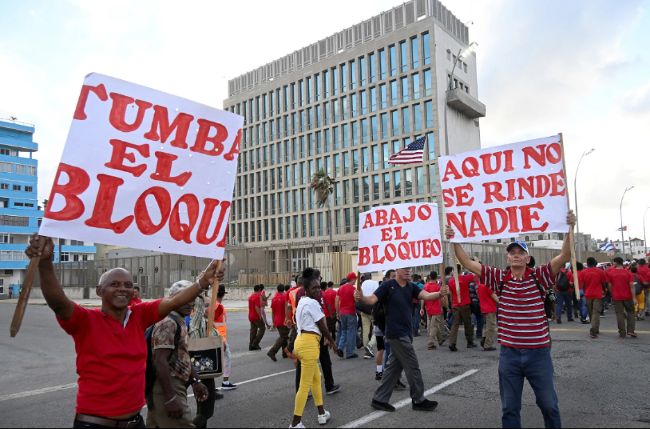
Cubans protest outside the US embassy, 2025: Bloomburg: Photographer Yamil Lago: AFP: Getty |
|
When the US struck and killed fishermen in small boats off the Venezuelan coast in violation of international law, human rights organizations from the UN, Latin America, the Caribbean and the US condemned the attacks. But those protesting voices soon faded like whistles in the wind.
The attacks on boats have resumed; 135 people have been killed and counting. Now it’s purely a blood sport, given that the US itself changed its story that these boats were transporting fentanyl. Suffering no consequences for the attacks, the US sent troops into the Venezuelan capital and kidnapped its president, with the loss of another 100-plus lives. Responses from international organizations? More whistling in the wind.
The Progressive International, composed of seasoned activists from all over the world, immediately organized an emergency global conference to discuss Venezuela and to prepare a united, concerted response. But even as the Nuestra América conference met in Bogotá, Venezuela’s crisis was superseded by Cuba’s — the US oil blockade meant that Cuba had two weeks before the country would plunge into darkness. Trump’s attacks on “everything, everywhere, all at once” are dizzying.
José Luis Granados Ceja and Kurt Hackbarth went to Nuestra América as representatives of the Mexico Solidarity Project. They joined other activists from Mexico and nations around the world who agreed that Venezuela and Cuba’s sovereignty must be defended — or who will be next? Trump has already been threatening Mexico.
Taking a cue from Minneapolis, it’s not a protest statement here and there that succeeds, but a determined and organized population raising their voices together, louder and louder — until Trump’s orders to invade, arrest or kill anyone opposing his attempt to subordinate all of the Americas, including the people of the United States of America, fade like a whistle in the wind. |
|
|
|

|
No, Trump, "America" Is Not the US |
|
|
José Luis Granados Ceja, an independent journalist, photographer and political analyst based in Mexico City, co-hosts MSP's podcast Soberanía with Kurt Hackbarth. He writes from an anti-imperialist perspective for both both English- and Spanish-language media media, covering Latin America for Drop Site News, and co-presenting with Kurt and guests on Sin Muros on Mexico's TV station, Canal Once. |
|
After the US military murdered Venezuelan fishermen and then kidnapped Venezuela’s president, Nicolas Maduro, an emergency international conference on the implications of the attack was called. You and Kurt Hackbarth went as representatives of the Mexico Solidarity Project. Why was it important for us to be there, and what did you hope to accomplish? |
|
|
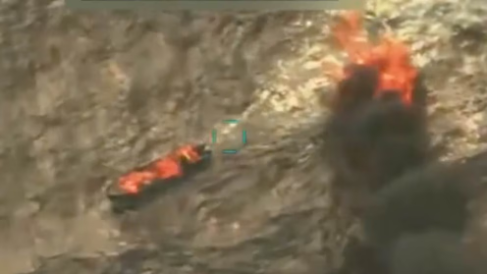
US military bombs small boat in the Caribbean: ABC News, 2025 |
|
When the US committed extrajudicial murders of fishermen leaving no survivors, witnesses or evidence, anti-imperialists around the world read it as a prelude for something worse. More violence was to come. |
|
When it did come, while not a surprise, the form of it was still a shock: a brazen invasion resulting in the deaths of around 70 Venezuelan soldiers and civilians and 32 Cuban military personnel safeguarding the president.
Progressive International (PI) jumped into high gear. Its co-director, David Adler, is part of Mexico Solidarity Project’s Rapid Response Media network, and he informed us of their plan for the Nuestra América conference. |
|
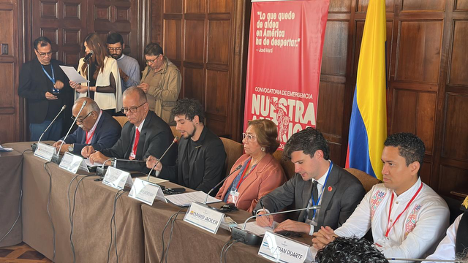
The international law violations were alarming to all countries, but the US actions were particularly dangerous for Latin America. The meeting took place in Colombia, whose president, Gustavo Petro, is a member of PI. Ninety delegates from 20 countries coalesced in just a few short weeks. |
|
|
David Adler with Colombian Foreign Minister Rosa Yolanda Villavicencio |
|
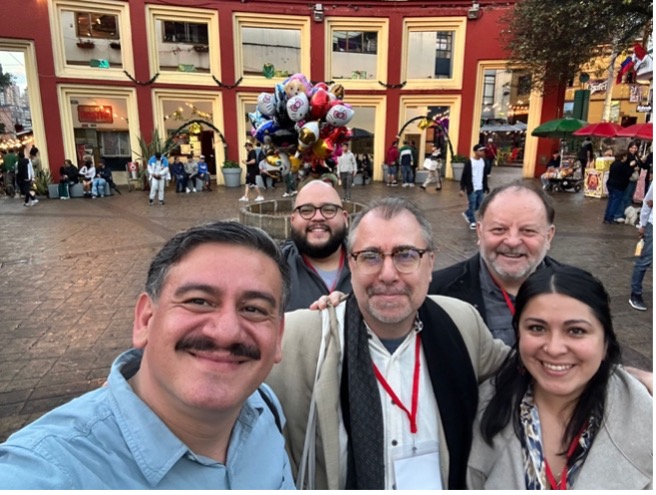
Kurt Hackbarth and I were invited to participate. The MSP decided it would be good for us to be there as journalists so that we could report firsthand on this important gathering. We presented our analysis on the Soberanía podcast when we returned. |
|
|
Front: José Luis, Kurt Hackbarth and Veka García. Back: Hugo Macías and Martín Atilano. |
|
But Kurt and I are not just journalists; we are political activists who also went as MSP organizers. The main goal of the MSP is to build support for Mexico’s sovereignty and its right to implement its 4th Transformation project. By attending the conference, we met face-to-face — still the best way to build working relationships — with other builders of cross-border solidarity. |
|
We connected with US activists from DSA, with people from a Morena chapter in Chicago, Mexican congresswoman Andrea Navarro, Canadian activists and many others.
You were a staff writer for Venezuelanalysis and still have on-the-ground connections there. Inside Venezuela, what was the reaction to the US attacks? |
|
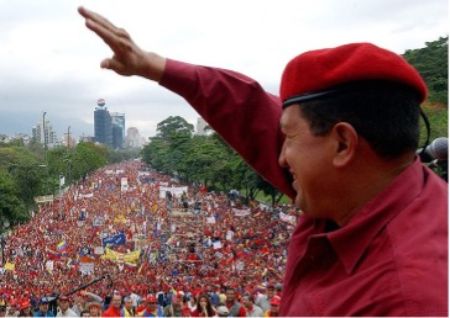
Violent opposition is something Venezuelans are used to. Ever since Hugo Chávez was elected in 1998 and began to implement a “Bolivarian Revolution,” a project to put the people first, to climb out from under the US boot, and to unite Latin America, the right-wing has used violent insurrectionary strategies to bring Chavismo down. |
|
|
Former Venezuelan President Hugo Chávez waves at a sea of humanity: UG Diplomat, 2024 |
|
Between 2014 and 2017, they employed street protests to provoke a violent government response and then pointed to that response as an excuse to call for US intervention to protect the supposedly democratic protesters.
The Venezuelan right-wing opposition got what they wanted on January 29. The US military put boots on the ground in Caracas, the capital, and president Maduro was kidnapped right in his own offices. But the Chavista movement continued to bet on their project; the day after the kidnapping, demonstrations defended the Bolivarian Revolution.
|
|
|
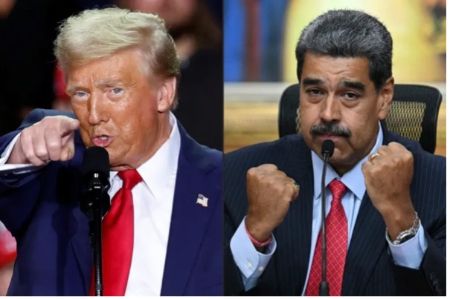
Maduro accused the Trump administration of fabricating a war against him [AFP]: Al Jazeera |
|
Strategically, Maduro’s kidnapping achieved a lot for the US. It sent a chill down the spine of left-leaning governments in Latin America, including Cuba, Colombia, Nicaragua and Mexico.
The Venezuelan opposition doesn’t have much support. Trump was correct on one thing; he saw Machado’s negatives — she wouldn’t be able to unify the country. Now Venezuela is in a new phase. |
|
Delcy Rodríguez backed the National Assembly decision to revise the country’s oil laws in accordance with some of Trump’s demands. She has released some prisoners and has called on all of Venezuela to chart a new course of unity and of democratic — not insurrectionary — opposition. She noted that the country had paid a high price for its internal polarization.
But in my opinion, those — like Machado — who cheered the invasion should not have any place or voice in Venezuela’s future. They’re traitors!
The conference’s concrete result was the San Carlos Declaration. What’s its significance, and can it lead to concrete actions? |
|
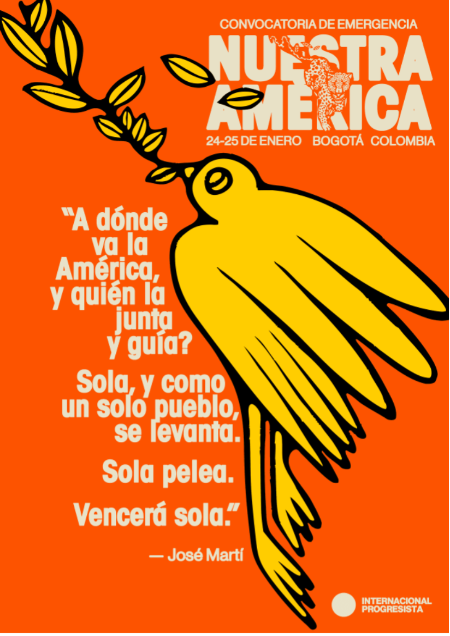
The Declaration outlines a new continental project affirming that the future of America lies in the hands of its peoples. America, as Bad Bunny enumerated at the Super Bowl halftime show (!), includes myriad diverse nations and peoples; it is not the US. Their sovereign decisions must be defended by all.
It articulates the alternative to Trump’s "Donroe" Doctrine. It says “no” to killings, unilateral attacks, electoral interference, resource extraction and imperial domination. “For the past twelve months — and for the past two centuries — Nuestra América has been the stage for these acts of aggression. But we also know how to resist!” asserted Colombia’s Minister of Foreign Affairs, Rosa Yolanda Villavicencio. |
|
|
Nuestra América: Where will America go? |
|
As one concrete action, Nuestra América is planning a flotilla of aid to Cuba, and Mexico is also doing what it can. What can people in the US do to support the Declaration? |
|
|
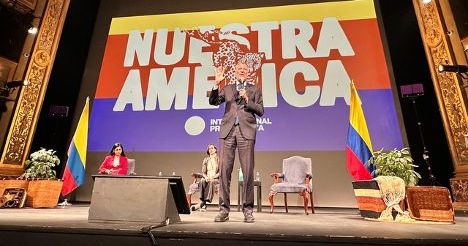
Bill de Blasio speaking at Nuestra América conference |
|
Since Trump is a US creation, people in the US have a key role to play. Bill DeBlasio, the former progressive mayor of New York, spoke about the need to elect Democrats. But the majority of participants agreed that “Blue imperialism isn’t going to save us.” They must continue to resist fascism at home and connect it to the fight to defend Latin America. |
|
Because the MSP brings factual information and a left analysis to people within the US and builds concrete relationships between US and Mexican activists, we can play a role.
Donate to the Nuestra América aid flotilla to Cuba here! |
|
|
NEW! Sign up here for weekly delivery of COMPAÃEROS! |
|
Compañeros is the weekly newsletter of Mexico Solidarity Media, delivering all of our news stories, analyses, interviews and episodes of the podcasts Soberanía and El Taller, the Mexico Solidarity Bulletin, translations from Mexican media, photos and more! |
|

|
What’s the Price of Solidarity with Cuba? |
|
|
Kurt Hackbarth is a Mexico City–based writer, playwright, and freelance journalist. He writes for Jacobin magazine, co-hosts MSP’s podcast Soberanía, and is a presenter on Mexico TV Canal Once's programs Sin Muros and Masiosare. He co-founded the publishing house Matanga! Follow him on X @kurthackbarth. |
|

|
The following article has been adapted from the much longer Feb 14, 2026, article by Hackbarth in Jacobin. It has been edited for length and clarity.
After the US abduction of Venezuelan president Nicolás Maduro on January 3, president Trump extended the threat to Mexico, trotting out his oft-repeated chestnut about organized crime running the country. He proceeded to state, “We will now start hitting land with regard to the cartels.”
Faced with his blustering threats, Mexican president Claudia Sheinbaum returned to her previously successful strategy: she picked up the phone. She had calls with Trump on January 12 and January 29. She once again rejected the US “offer” of military intervention, instead touting her own security policy — boasting a 40 percent reduction in homicides and a 50 percent drop in fentanyl crossing the border.
But on the same day, Trump’s post-Venezuela belligerence took another turn. He signed an executive order painting Cuba as an “unusual and extraordinary threat” to US national security, thus justifying 80% tariffs on “imports of… products of a foreign country that directly or indirectly …provides any oil” to the island.
That “foreign country” was clearly Mexico, and it poses a conundrum for Sheinbaum.
Sheinbaum has opted for a variant of her previous tariff postponement strategy — she is suspending oil shipments while sending an initial eight hundred tons of non-oil aid, including food and hygienic products. She is attempting to buy time for more negotiation with the ultimate goal of resuming oil shipments to Cuba and avoiding the economic hit of new tariffs.
But the Venezuela operation and the US government’s obsession with regime change in Cuba make any US compromise with Sheinbaum increasingly unlikely — it would take nearly miraculous diplomatic jujitsu. In short, Mexico will soon have to show its hand.
It does have some cards to play. Owing to tariffs, the US lost 68,000 manufacturing jobs in 2025, while Mexico ended the year with record levels of foreign direct investment and a trade surplus with the US. Plus, much of any tariffs on Mexico would actually fall on US companies located there and exporting back to the US.
But for Sheinbaum, the other problem is that nearly a quarter of the US Navy is parked in the Caribbean watching over Venezuela and enforcing the “quarantine” of Cuba. The US could seize and board (or bomb with drones) any oil-bearing tankers and then take advantage of the ensuing diplomatic crisis to bomb Mexico on land.
The alternative, however, is to let Cuba starve.
If Mexico were to cede on an issue so symbolically important to its own self-conception of sovereignty, the Trump administration would smell blood. It could affect everything from the current USMCA review to the treatment of Mexican migrants by ICE to US attempts to control strategic mineral stores.
For Mexico, defending self-determination anywhere in the region is defending its own. The international community and activists within the US must make sure it does not stand alone. |
|
Sign up for a free Mexico Solidarity Bulletin subscription!
And check out:
*MEXICO SOLIDARITY MEDIA: Our website for current news and analysis in English *COMPAÑEROS: NEW! Sign up here for Mexico Solidarity Media’s weekly newsletter *¡SOBERANÍA! (Sovereignty): For entertaining exposés of events in Mexico in English, catch our podcast with José Luis Granados Ceja and Kurt Hackbarth. *Sin Muros with English subtitles: José Luis and Kurt host a weekly TV show on Canal Once that analyzes Mexico-US relations with English subtitles.
Drop a line to meizhului@gmail.com |
|

|
Recent news reports and commentaries, from progressive and mainstream media, |
|
Natascha Elena Uhlmann, Mexico City’s Trolleybus Workers Could Bring the City to a Grinding Halt Labor Notes. Their union is one of Mexico’s oldest democratic unions. The 2,700 workers are fighting for raises, job security language, and more hires and training in order to expand and maintain Mexico City’s electric transport infrastructure.
Alejandro Calvillo, La Copa de la Diabeti-Cola Sin Embargo. La Copa Mundial comenzará a recorrer el territorio con la marca de Coca-Cola al frente para generar la idea de que fútbol es Coca-Cola.
Labeling with a taste of Coca Cola Poplab. “I am a consumer of their products, a daily consumer; I can tell you that the President drinks Coca Cola every day”. These were Enrique Peña Nieto’s words in 2016, just two months before the Secretary of Health declared a national emergency over the widespread occurrence of obesity and diabetes
Etiquetado con sabor a Coca Cola Poplab. “Yo soy un consumidor de sus productos, un consumidor cotidiano; les puedo decir que el presidente de la República toma Coca Cola todos los días”. Estas fueron las palabras de Enrique Peña Nieto, dos meses antes de que la Secretaría de Salud emitiera, en 2016, una declaratoria de emergencia nacional por obesidad y diabetes.
Emir Olivares Alonso, Mexico City: Collection Center in the Zócalo Has Gathered 6 Tons of Food for Cuba Resumen Latinoamericano English. The collection demonstrated the solidarity of Mexicans with the island, which has been besieged by the recent oil embargo decreed by the US president.
Darío Brooks, Por qué los mexicanos trabajan tantas horas (y por qué es difícil que cambie con la reducción de la jornada) BBC News Mundo. Si no existe una contabilidad precisa de horas de trabajo, como recomienda la OCDE, quedará a discreción de los empleadores la repartición de las cargas de trabajo.
Amy Stillman, Visa’s Takeover of Prosa Rejected by Mexico’s Antitrust Watchdog Bloomberg. The CNA said in a statement Friday that the solutions proposed by Visa and Prosa “were not suitable or sufficient to avoid the risk to markets and consumers detected by the commission.”
Viri Ríos, Qué significa ser soberano Milenio. Hay dos ámbitos en los que los intereses de México y Estados Unidos discrepan de manera fundamental.
Gaby Cepeda, Art in the Age of Claudia Sheinbaum North South Notes. A bit of dubious characterizations of the Gen-Z protests but the essay maps some of the substantive anxiety around Mexico’s cultural industries and the state’s retreat from support.
Fernando Gálvez de Aguinaga, Derecho a la vivienda y al patrimonio cultural La Jornada. No podemos permitir que groseras, especulativas y destructivas empresas inmobiliarias y descastadas fundaciones que han perdido rumbo y su misión original, avancen en la destrucción de la ciudad Déco y su patrimonio cultural. |
|
|
|

|
The Mexico Solidarity Project brings together activists from various socialist and left organizations and individuals committed to worker and global justice. We see the 2018 election of Andrés Manuel López Obrador as president of Mexico as a watershed moment. AMLO and his progressive Morena party aim to end generations of corruption, impoverishment, and subservience to US interests. Our Project supports not just Morena, but all Mexicans struggling for basic rights, and opposes US efforts to undermine organizing and Mexicoâs national sovereignty.  Editorial committee: Meizhu Lui, Bruce Hobson, Agatha Hinman, Victoria Hamlin, Courtney Childs, Pedro Gellert.  To give feedback or get involved yourself, please email us! |
|
Subscribe! Get the Mexico Solidarity Bulletin in your email box every week. |
