|

|
The weekly newsletter of the Mexico Solidarity Project |
|
Every issue archived online at mexicosolidarityproject.org/archives/ |
|
May 06, 2026 |
|
|
|
Land and Liberty: The Struggle Continues |
|
Meizhu Lui, for the editorial team |
|
|
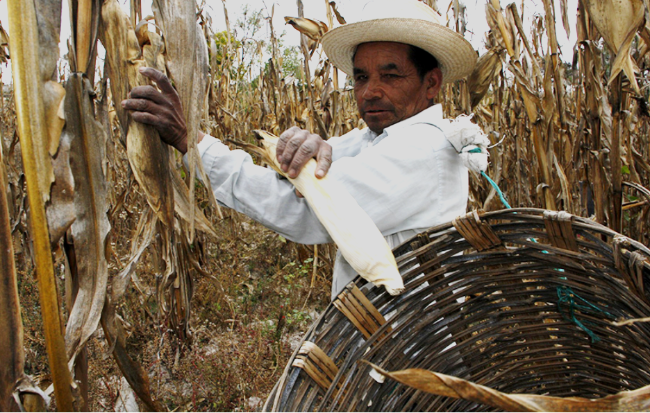
La milpa uses a variety of crops in one planting, demonstrating 50% higher corn yields when grown with other species as part of la milpa. Photo courtesy of Onsway |
|
“You need three ears of corn, one to eat, one to sell and one for next year’s planting.” That’s how African American scholar and activist W.E.B. DuBois explained the importance of “wealth” — that third ear of corn — to Black farmers.
After the Civil War, the Union Army’s General Sherman promised former slaves “40 acres and a mule.” It was clear that they couldn’t be free if they didn’t control their own labor. But almost immediately, Southern states systematically dispossessed Black farmers of their holdings, reducing them to near-slave conditions as farm hands. Black land ownership, Dubois concluded, was the key to their freedom.
In Mexico, Indigenous farmers practiced Dubois’s common-sense principles, feeding themselves and their community and ensuring the next year’s harvest. But as long-time campesino activist José Jacobo tells us, after Spanish colonizers privatized communal land, small farmers endured a long history of dispossession — up to and including today.
Both foreign and domestic agribusinesses have severely weakened the ability of farmers to sell their crops or accumulate savings, leaving them with only enough to feed themselves — symbolically, with just one ear of corn. The three elements of the cycle of self-sufficiency essential for sustaining rural communities have been dismantled.
For them, like the Black farmers, they still need “land and liberty,” as the peasant leader Zapata demanded in the 1910 Revolution. In 1994, the Zapatista movement brought his demand up to date, identifying NAFTA as a deadly blow to Indigenous farmers because “free” trade means freedom to exploit. Their alternative vision of a return to social land ownership could provide health, abundance and self-sufficiency for themselves and for all of Mexico.
Without liberty, campesinos cannot have land. Without land, they cannot have liberty. From 1521 to 2026, the struggle continues. |
|

|
Restore Campesino Rights, Reject the USMCA |
|
|
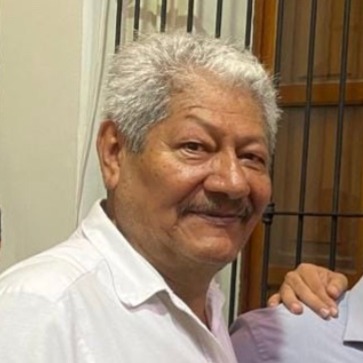
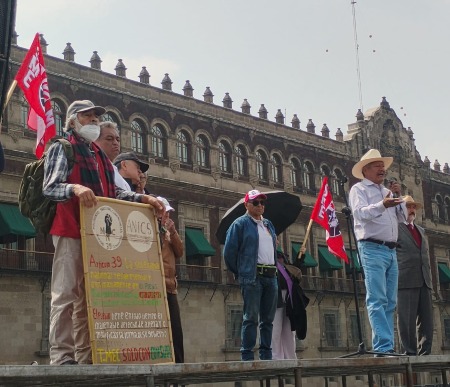
José Jacobo Femat is a peasant leader, President of the Central of Peasant and Popular Organizations (COCYP) and a member of the National Indigenous, Peasant and Social Assembly (ANiCS). A native of the state of Durango, he is an agrarian activist who has organized defense of the agrarian, social and political rights of Indigenous peoples and peasants. In 2024, he received recognition and gratitude for his 58 years of activism from the organization, Desde la Izquierda (From the Left). |
|
What is the traditional Mexican way of managing the land?
Before the Spanish arrived, the people used all land and water communally — a system of social ownership that allocated plots of land to families for cultivation. It apportioned part of the harvest for each family’s own consumption and apportioned another part to the community.
The Spanish abolished all this. Following the conquest, the Spanish Crown took ownership and granted enormous areas of land to the Spanish elites. Peasants became indebted laborers, although some communal properties did manage to survive. |
|
But following the first revolution — which overthrew Spanish rule in 1810 — the new government didn’t restore land to the communities. On the contrary, they concentrated it into large plantations — haciendas — and permitted foreigners to appropriate large tracts. In other words, our dispossession under NAFTA and the USMCA is nothing new. |
|
|
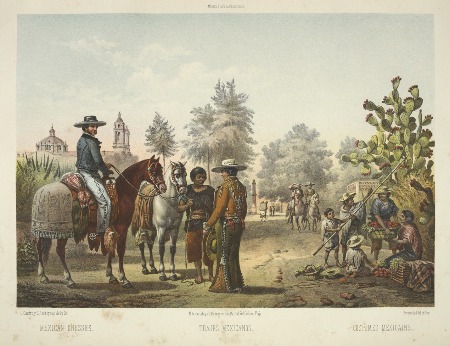
1856 Lithograph depicting Mexican rancheros and campesinos |
|
What rights did peasants gain during the Mexican Revolution?
Naturally, it was the campesinos, rural peasant farmers, who drove the 1910 Revolution. The primary demand of Emiliano Zapata Salazar and Francisco Villa — the major peasant leaders — was to return land to social ownership. Following their victory, the vast haciendas were broken up, and the land was redistributed among the peasants. Mexico’s total land area spans 198 million hectares; slightly more than half — specifically, 103 million hectares — was allocated as social property.
The 1917 Mexican Constitution outlined three types of property: public property belonged to the State, private property to private individuals and social property to peasant communities, many of them traditional ejidos. The Constitution stated that social land possessed three key characteristics: it was imprescriptible, not subject to loss through the passage of time; unseizable, protected from foreclosure; and inalienable, incapable of being sold. |
|
|
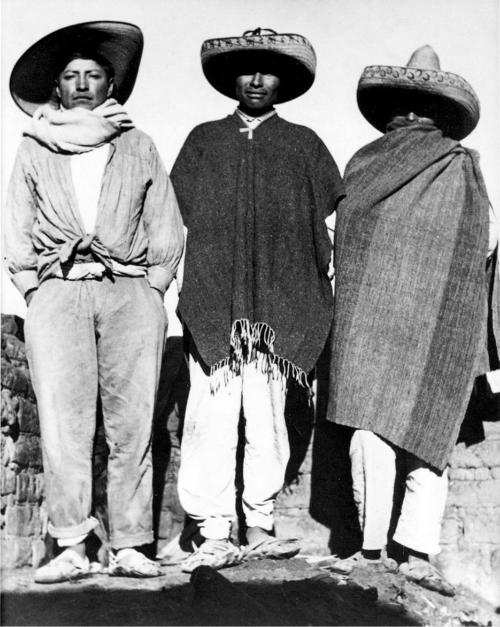
Campesinos, State of Veracruz, Mexico: Tina Modotti,1927 |
|
With sale prohibited, what happened if ejidatarios (original members of an ejido) died? They passed their ownership right down to their children, perpetuating the ejido over generations.
In addition to land redistribution, the post-revolutionary government established numerous services, such as credit, insurance and technical assistance. They also provided inputs like seeds and fertilizers, equipment and infrastructure construction and purchased basic agricultural products from peasants at fair prices. These elements were essential for farmers and enabled the country — for over fifty years — to maintain sufficient production to meet national demand while exporting surpluses, a trend that continued until 1982. |
|
Did NAFTA reverse those gains?
In 1992, the government of the neoliberal Salinas de Gortari amended the Constitution to permit converting social property into private property, meaning that individual ejidatarios could lease or sell their plots. Since then, more than five million hectares have been privatized, paving the way for the resurgence of gigantic private estates, where wealthy individuals control both production and labor conditions. |
|
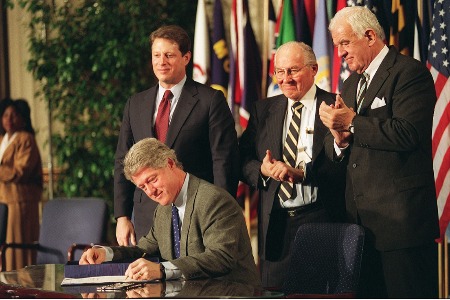
In 1994, NAFTA threw open the doors to foreign corporations. The Mexican government granted concessions for land and water resources to mining, agricultural, petroleum and manufacturing firms, including the automotive sector. This set off an intensive land grab by US and Canadian businesses that had been waiting for this economic opportunity. |
|
|
President Bill Clinton signs the controversial North American Free Trade Agreement December 08 1993 as Al Gore, Bob Michel and Tom Foley watch; Paul J. Richards/AFP/Getty Images |
|
Foreign companies showed no qualms whatsoever about plundering mineral wealth and devastating the Mexican environment through deforesting and destroying biodiversity, contaminating the soil and monopolizing freshwater rights — surface and groundwater — across the length and breadth of the country. |
|
|
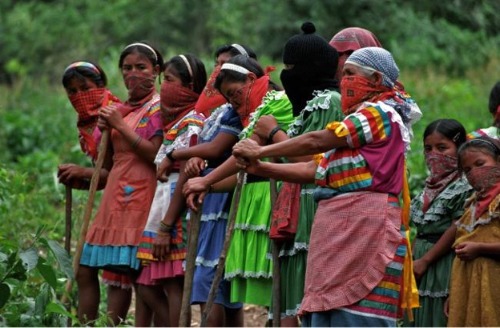
In 1998, Zapatista women in Amador Hernadez demanded daily that the Mexican military leave the village communal landholdings. (Photo by Tim Russo) |
|
Naturally, widespread protests arose. The Zapatista movement in Chiapas emerged as a direct response to NAFTA; it totally rejected neoliberal globalization, and its members sought to create an alternative social model based on the ancient Indigenous communal system. |
|
Some of us residing in other parts of the country participated in this movement; however, its organizing was confined to a specific region of the national territory and never scaled up to become a national political project that could unite other movements and states across the Republic. Nevertheless, we all stand behind its defense of the rights of Indigenous peoples and communities in the face of corruption, repression, assassinations and environmental disaster. Their demands remain our demands.
Recently, farmers blocking highways have been in the news. Was your organization involved?
Large-scale farmers organized the demonstrations. They are the new private landowners emerging from the neoliberal model that opened up the land market. |
|
My organization, the COCYP, is a national coalition of small organizations — ejidos, peasant communities and grassroots groups — representing small-scale producers. Our objective is to restore the agrarian rights eliminated by the neoliberal regime; we seek a new agrarian reform for the benefit of 5.5 million ejidatarios and communal landholders. |
|
|
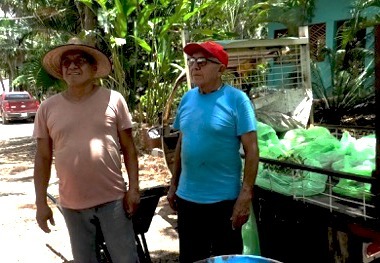
Two brothers working on their small farm, 2024 |
|
We do face some of the same problems as large-scale farmers. Before 1990, Mexican agriculture was sustainable because a state agency guaranteed the pricing and purchase of staple grains that ensured our survival. Today, farm product prices are set far away in the Chicago Mercantile Exchange, controlled by giant food corporations. These prices are simply too low for any farmer large or small to survive on without government subsidies.
Therefore, those carrying out the blockades are demanding government subsidies for various crops, such as corn, wheat, beans, rice, milk, meat and others. And, to halt the dumping of US corn that floods the Mexican market at extremely low prices, they are requesting that staple grains be excluded altogether from the USMCA. |
|
|
José Jacobo Femat speaking at a rally at the Zocalo, Mexico City |
|
We agree with these demands — but have our own demands too! First and foremost, we propose restoring the rights guaranteed under Article 27 of the 1917 Mexican Constitution, which stipulated that the State must regulate the use of natural resources — the public wealth — to conserve them for everyone’s benefit. That provision paved the way for the expropriation of privately owned land needed for public use and for restrictions on foreign ownership within a 100-kilometer zone along the borders and a 50-kilometer zone along the coastlines. |
|
We also demand the reinstatement of all farm services eliminated by NAFTA.
Free trade agreements have effectively turned Mexico into a colony of US multinational corporations — such as Cargill and Archer Daniels Midland —within the agricultural sector. These companies reap enormous profits but pay no taxes in Mexico; it is nothing short of theft! Indigenous peoples’ rights are completely disregarded. Predatory mining, forestry and tourism enterprises are encroaching on Indigenous communities, preventing them from exercising stewardship over their land and water. This violates current laws and the Constitution itself.
Therefore, those we represent demand that Mexico reject the USMCA entirely!
What arguments do you have that would generate broad support for jettisoning free trade agreements?
Food quality. Free trade has made the Mexican diet much worse. Instead of fresh produce, Mexicans regularly consume ultra-processed foods and sugary beverages, causing a high incidence of obesity, diabetes, cancer and hypertension. This is a national disaster!
Self-sufficiency. Today, Trump demands that Mexico again throw its doors wide open to exploitation by US corporations under a revamped USMCA. We advocate a return to the days of toxin-free Mexican-grown food for Mexican people. We don’t need imports; we can be food self-sufficient.
Protection of sovereignty. Last year, Congressional Representative Roselia Suárez proposed a constitutional amendment to restore the rights of campesinos as the 1917 Constitution once guaranteed. She highlights the historical importance of peasants, Indigenous peoples and Afro-Mexicans as the bedrock of the Mexican Revolution. We are the ones that most strongly insist, without reservation, on Mexico’s sovereignty regarding protection of our natural resources.
Since the days of the Spanish Conquest, campesino demands remain the same: Land and Liberty! |
|
|
NEW! Sign up here for weekly delivery of COMPAÃEROS! |
|
Compañeros is the weekly newsletter of Mexico Solidarity Media, delivering all of our news stories, analyses, interviews and episodes of the podcasts Soberanía and El Taller, the Mexico Solidarity Bulletin, translations from Mexican media, photos and more! |
|

|
US Doesn’t Give a Shit About Drug Traffic |
|

|
José Luis Granados Ceja is a journalist and political analyst based in Mexico City. He currently covers Latin America for Drop Site News. He is the co-founder of MSP's Soberanía podcast and a presenter on the show Sin Muros on Mexico’s Canal Once. He focuses on political issues, social movements, elections and human rights. Follow him @GranadosCeja |
|
|
For all their bluster about the dangers from “narcoterrorist” organizations, we need to be clear: the US doesn’t give a shit about drug trafficking, especially the Donald Trump administration. If they did, the US president wouldn’t have pardoned and released former Honduran President Juan Orlando Hernández, a narco trafficker convicted in New York who, according to leaked audios, is returning the favor by conspiring against leftist governments in the region. If Washington gave a shit about organized crime, their closest regional ally would not be Ecuador’s Daniel Noboa, who faces credible allegations of ties to drug trafficking and transnational criminal organizations.
US drug policy in Latin America is just a means to an end: dominance and control, an extension of their imperialist foreign policy. That’s how we should understand the US seeking the arrest and extradition of Sinaloa Governor Rúben Rocha Moya on alleged drug trafficking offenses.
President Claudia Sheinbaum announced that the federal Attorney General’s Office will investigate the allegations, the correct action for any sovereign state. We should treat US indictments — largely based on testimony by plea-seeking witnesses — with a grain of salt. Should the allegations against Rocha, who correctly has stepped away from office, prove credible, he should be tried inside Mexico. The US cannot be trusted.
Given its timing, distrust of the indictment has only grown. It was made public during a diplomatic crisis between Mexico and the US after a car crash in opposition-run Chihuahua inadvertently revealed that CIA agents are illegally operating in Mexico. Since 2020, a law passed under President Andrés Manuel López Obrador expressly bans foreign agents from participating in operations.
The Rocha indictment is a “hail Mary” to save US ally Maru Campos, the right-wing governor who allowed the CIA to work illegally inside Mexico. It reveals US strategy — if they can’t work with Mexico’s national government, then they will find a vendepatria, or traitor, who will let them in.
Sheinbaum hoped to characterize the illegal participation of US agents in Mexican operations as a one-off exceptional case, but reports say there were other operations involving US agents. Since US Ambassador to Mexico Ron Johnson himself comes from a long and sordid CIA background, it would be foolish to think infiltration will stop.
Undoubtedly, the US DOJ’s unsealing of the indictment against Rocha and nine other public officials has created the most serious crisis facing the Fourth Transformation; how Sheinbaum handles this will likely determine her government’s future. A real danger is that the US could conduct a Venezuela-style operation and kidnap Rocha, as when the US kidnapped Ismael El Mayo Zambada in July 2004.
But this scenario is a trap for the opposition. It reveals that foreign intervention is their only hope. Mexicans won’t look kindly on politicians and political parties that embrace the empire, caring for US national security but not the lives of Mexicans. |
|
Sign up for a free Mexico Solidarity Bulletin subscription!
And check out:
*MEXICO SOLIDARITY MEDIA: Our website for current news and analysis in English *COMPAÑEROS: NEW! Sign up here for Mexico Solidarity Media’s weekly newsletter *¡SOBERANÍA! (Sovereignty): For entertaining exposés of events in Mexico in English, catch our podcast with José Luis Granados Ceja and Kurt Hackbarth. *Sin Muros with English subtitles: José Luis and Kurt host a weekly TV show on Canal Once that analyzes Mexico-US relations with English subtitles.
Drop a line to meizhului@gmail.com |
|

|
Recent news reports and commentaries, from progressive and mainstream media, |
|
Pablo Meriguet, Governor of Sinaloa slams US charges as slander against MORENA People’s Dispatch. Governor Rubén Rocha has categorically denied the charges and claims that this is a politically motivated attack.
Presidenta de Morena reafirma en México solidaridad con Cuba Prensa Latina. En su primer discurso como dirigente del gobernante, Ariadna Montiel sostuvo que el cerco impuesto por Washington “está derivando en una crisis humanitaria sin precedentes”.
Thousands Rally Across Yucatan for Higher Wages and Tax Relief on May Day Riviera Maya News. Other demands included reducing the workweek to 40 hours, implementing unemployment insurance, and strengthening union participation in national economic decisions.
Yeraldine Bonilla asume como gobernadora interina de Sinaloa tras licencia de Rubén Rocha Moya Telesur. Con este nombramiento, el departamento azteca inicia una etapa de transición administrativa mientras se resuelve el estatus legal de Rocha Moya.
Mexico to require federal projects to use local steel in response to US tariffs Reuters. While Trump's global tariffs have inspired âother countries, such as Canada, to try to scale back their dependence âon the U.S., Mexico has previously been reluctant to take steps that could irritate its largest trading partner, and the destination of 80% of its exports.
Víctor M. Quintana S., La intervención de baja intensidad y sus colaboradores La Jornada. La soberanía no se defiende con explicaciones rabonas.
Mexican Representative to the OAS Rejects Alleged Violations of Labor Rights of Cuban Doctors Resumen English. Encinas argued that cooperation with Cuba is a matter of sovereign and solidarity-based policy. “This is a legitimate and necessary agreement that draws on the best of the peoples’ traditions,” he stated.
Representante mexicano en la OEA rechaza presuntas violaciones a derechos laborales de médicos cubanos Cubadebate. Encinas defendió que la cooperación con Cuba responde a una política soberana y solidaria. “Se trata de un acuerdo legítimo y necesario que rescata lo mejor de las tradiciones de los pueblos”, expresó.
Pablo Meriguet, Mexico investigates US operations after two covert CIA agents die in traffic accident People’s Dispatch. Their deaths have sparked criticism regarding the presence of foreign agents on Mexican soil without the knowledge of the Mexican government.
Inicia marcha de la CNTE por el Día del Trabajo Desinformémonos. “Los dueños del gran capital siguen pregonando que la única manera de alcanzar una vida digna es por el esfuerzo individual, discurso apoyado por los gobiernos de derecha, lo cual es totalmente falso.” |
|
|
|

|
The Mexico Solidarity Project brings together activists from various socialist and left organizations and individuals committed to worker and global justice. We see the 2018 election of Andrés Manuel López Obrador as president of Mexico as a watershed moment. AMLO and his progressive Morena party aim to end generations of corruption, impoverishment, and subservience to US interests. Our Project supports not just Morena, but all Mexicans struggling for basic rights, and opposes US efforts to undermine organizing and Mexicoâs national sovereignty.  Editorial committee: Meizhu Lui, Bruce Hobson, Agatha Hinman, Victoria Hamlin, Courtney Childs, Pedro Gellert.  To give feedback or get involved yourself, please email us! |
|
Subscribe! Get the Mexico Solidarity Bulletin in your email box every week. |
